


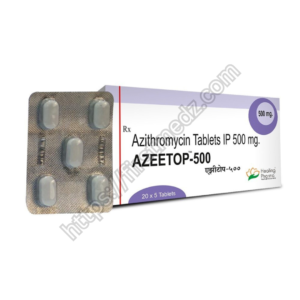
Description
Same active ingredient (azithromycin) as Zithromax®, the US brand. Azithromycin 500 mg is an Indian brand, made and licensed in India.
About Azithromycin 500 mg
Azithromycin 500 mg is a prescription tablet containing 500 mg of azithromycin, a generic macrolide antibiotic used to treat bacterial infections of the chest, sinuses, throat, ears and skin, as well as certain sexually transmitted infections. Its main practical advantage is a short course: most infections need only three days of tablets. Check the maker’s name and expiry date on the strip on arrival.
How does it work?
Azithromycin binds to the 50S subunit of the bacterial ribosome, the machinery germs rely on to make proteins. Without new proteins the bacteria cannot grow or divide, and the body’s defenses clear what remains. White blood cells absorb the drug and ferry it into infected tissue. It is eliminated slowly, with a half-life of about 68 hours, so it goes on working for several days after the last dose.
What is it used for?
- Community-acquired pneumonia, including atypical organisms such as Mycoplasma and Chlamydophila.
- Bacterial flare-ups of chronic bronchitis or COPD, and acute bacterial sinusitis.
- Strep throat and tonsillitis when penicillin is unsuitable, and middle-ear infection.
- Uncomplicated skin and soft-tissue infections.
- Genital chlamydia, non-gonococcal urethritis and chancroid.
Resistance to macrolides is increasingly common, so your doctor weighs local patterns and your history before choosing it. It does nothing for colds, flu or other viral illnesses.
How to take Azithromycin 500 mg
| Regimen | Typical use | Total dose |
|---|---|---|
| 500 mg once daily for 3 days | Chest, sinus, throat, ear and skin infections (usual UK course) | 1.5 g |
| 500 mg on day 1, then 250 mg daily on days 2–5 | The same infections (common US five-day course) | 1.5 g |
| 1 g (two tablets) as a single dose | Uncomplicated genital chlamydia and urethritis | 1 g |
Swallow each tablet whole with water, with or without food, at the same time every day. Keep antacids containing aluminum or magnesium at least two hours apart from your dose. Do not take more, or for longer, than your prescriber specifies. For chlamydia, many guidelines now prefer doxycycline, and azithromycin alone is not adequate for gonorrhoea, so sexually transmitted infections should be managed by a sexual health clinic, which can also arrange partner treatment.
What to expect after starting
Fever, cough or sore throat usually start to ease within two to three days. A cough may linger for a week or more while tissues recover. Contact your doctor if you are no better after three days, or sooner if you get worse, become breathless or develop chest pain.
What are the side effects?
The commonest are diarrhea, nausea, stomach pain and wind; headache, dizziness and a change in taste can also occur. Less often there is a rash, itching, vaginal thrush or tiredness. Hearing changes have been reported, mainly with prolonged use.
Get urgent help for a fast, pounding or irregular heartbeat or fainting; swelling of the face, lips or throat or difficulty breathing; a blistering or peeling rash; yellow skin or eyes, dark urine or pale stools; or watery or bloody diarrhea during or after the course.
Who should not take it?
- Anyone allergic to azithromycin or another macrolide, such as erythromycin or clarithromycin.
- People who previously had jaundice or liver problems linked to azithromycin.
- Caution with long QT, a slow heart rate, heart failure, low potassium or magnesium, or other QT-prolonging medicines, including amiodarone, sotalol, some antipsychotics and fluoroquinolone antibiotics.
- Also caution in liver disease, severe kidney impairment and myasthenia gravis.
Tell your prescriber if you take warfarin, digoxin, colchicine, ciclosporin or ergot medicines, because their levels or effects can change. In pregnancy, azithromycin is prescribed when a doctor judges it clearly needed; it is, for example, a recognized treatment for chlamydia in pregnancy. Small amounts pass into breast milk, so mention it if you are breastfeeding.
Pack sizes and storage
Supplied in strips of 10 tablets, in packs of 30, 50, 100, 200, 300, 500 or 1,000, from $45. A typical course uses three tablets, so buy only what your prescription covers. Store below 86°F (30°C) in the original strip, away from moisture.
Frequently asked questions
Is this the same as Azee 500?
It has the same ingredient and strength as Azee 500 mg, Cipla’s brand; Azicip 500 mg is another version.
Is there a lower strength?
Azee 250 mg suits the later days of a five-day course, and children usually take Azithromycin 100mg DT dispersible tablets.
Can I drink alcohol?
No direct interaction is known, but alcohol can worsen stomach upset, so keep it light. More items are in More Product.
General information for patients, not a diagnosis or treatment plan. Azithromycin 500 mg is a prescription-only antibiotic; take it only when a clinician has confirmed a bacterial infection, exactly as they direct.