


Description
About Cabgolin 0.5 mg
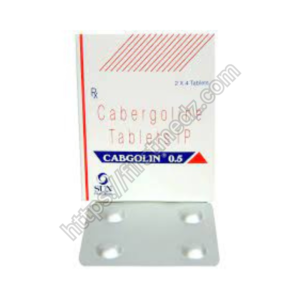
Cabgolin 0.5 mg is a prescription tablet containing 0.5 mg of cabergoline, made by Sun Pharmaceutical Industries Ltd, used to treat hyperprolactinemia, including microprolactinomas and macroprolactinomas of the pituitary gland. It is the strength most often used for maintenance, since a typical weekly dose of 0.5 to 1 mg can be given as one or two tablets.
How does Cabgolin 0.5 mg work?
Cabergoline is a selective, long-acting agonist of dopamine D2 receptors. By acting on the pituitary cells that make prolactin, it suppresses hormone release and, over weeks to months, reduces the size of most prolactin-secreting tumors. Normal prolactin allows the hormones that control ovulation, sperm production and sex drive to recover.
How to take Cabgolin 0.5 mg
- Typical maintenance: 0.5 mg once or twice a week, or as set by your endocrinologist.
- Take each dose with food on the same days each week.
- Your doctor increases the dose only after a prolactin test and at least 4 weeks on the current dose; US labeling describes a maximum of 1 mg twice weekly for hyperprolactinemia.
- For 0.25 mg doses, Cabgolin 0.25 mg avoids cutting tablets.
Long-term monitoring
| Check | Purpose |
|---|---|
| Prolactin blood test | Guides each dose change, then confirms control every few months |
| Pituitary MRI | Shows whether a prolactinoma is shrinking |
| Echocardiogram | Looks for valve thickening, at baseline and during long-term use |
| Blood pressure | Picks up low pressure after early doses |
| Mood and behavior | Screens for depression and impulse-control problems |
Can treatment be stopped?
Withdrawal may be tried when prolactin has stayed normal for a sustained period and imaging shows the tumor has gone or shrunk markedly, often after a gradual dose reduction. High prolactin returns in a substantial share of people, most often within the first year, so levels are rechecked regularly after stopping.
Planning a pregnancy
Fertility often returns within weeks of starting, so discuss your plans with your doctor early. Cabergoline is generally stopped as soon as pregnancy is confirmed; available data have not shown an increase in birth defects, but exposure is kept as short as possible. Women with macroprolactinomas need closer follow-up, including visual field checks, because the tumor can grow during pregnancy. Cabergoline stops milk production, so it is not taken while breastfeeding.
Who should not take it?
Avoid cabergoline with known heart valve disease, a history of fibrotic lung, pericardial or retroperitoneal disease, uncontrolled hypertension or hypersensitivity to ergot derivatives. Severe liver impairment, low blood pressure and psychotic illness call for caution.
What are the side effects?
Possible effects include nausea, headache, dizziness, weakness, constipation and stomach upset, which may be reduced by taking the dose with an evening meal. Seek urgent help for chest pain, breathlessness, persistent cough, swelling of the ankles, fainting, black stools or vomiting blood, or behavior changes your family finds worrying. Do not drive if you feel very sleepy.
Interactions
Dopamine antagonists (antipsychotics, metoclopramide) work against cabergoline. Clarithromycin, erythromycin and other macrolides may boost its levels, and blood pressure–lowering drugs increase the chance of feeling faint.
Pack sizes and storage
Supplied as 4 tablets per strip, in packs of 12, 24 or 36, from $21. Store in the carton below 77°F (25°C) and protect from moisture.
Frequently asked questions
How quickly does prolactin fall?
Levels start dropping within hours of the first dose, and many people reach normal values within the first month or two.
Is there an equivalent from another brand?
Caberlin 0.5 mg and CB-Lin 0.5 mg also contain 0.5 mg of cabergoline.
Where are related medicines listed?
In the More Product category.
Educational content only. Cabgolin 0.5 mg is a prescription medicine; regular prolactin tests and heart checks are part of safe long-term use.