

Description
Same active ingredient (clindamycin) as Cleocin T®, the US brand. Acnesol A Nano Gel 15 gm is an Indian brand, made and licensed in India.
About Acnesol A Nano Gel
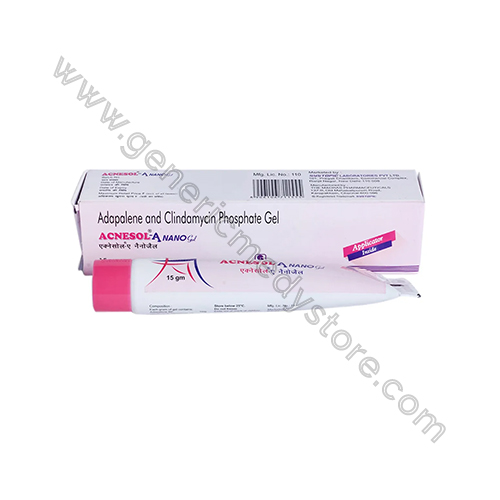
Acnesol A Nano Gel is a prescription topical gel containing clindamycin 1% together with the retinoid adapalene 0.1%, made by Systopic Laboratories Pvt Ltd, used to treat mild to moderate acne that mixes inflamed spots with blackheads and whiteheads. The added adapalene is what sets it apart from plain Acnesol Gel, so confirm the composition printed on your carton before you start. The product title mentions 15 g, while the pack details list 20 g per tube.
How does Acnesol A Nano Gel work?
The two ingredients tackle different stages of a breakout. Clindamycin, a lincosamide antibiotic, blocks protein production in Cutibacterium acnes, the skin bacterium that fuels inflammation inside clogged pores, so red papules and pustules settle. Adapalene is a third-generation retinoid that acts on the lining of the hair follicle, slowing the buildup of sticky skin cells that forms comedones and calming inflammatory signals. The maker describes the base as a nano formulation intended to spread thinly and reach the follicle; there is little independent evidence that this changes results compared with a standard gel.
How to use Acnesol A Nano Gel
- Use it once a day, in the evening, unless your doctor sets a different schedule.
- Wash with a mild, soap-free cleanser and lukewarm water, pat dry and wait 10 to 20 minutes so the skin is fully dry.
- Take a pea-sized amount for the whole face, dot it over the forehead, cheeks and chin, then spread a thin film.
- Treat the whole acne-prone zone, not just single spots, because the retinoid works by preventing new ones.
- Keep it away from the eyes, lips, the creases beside the nose and any cut, scraped or sunburned skin.
- Wash your hands afterward. Each morning, apply a non-comedogenic moisturizer and a broad-spectrum SPF 30 or higher sunscreen.
What to expect week by week
- Weeks 1–3: dryness, tightness, flaking or stinging is common while skin adjusts, and some people see a temporary flare as blocked pores come to the surface.
- Weeks 4–8: inflamed spots usually begin to fade and fewer new blackheads appear.
- Weeks 8–12: the full effect is normally visible; review progress with your doctor at this stage rather than continuing indefinitely.
If irritation is strong, switch to every other night for a week or two, then return to nightly use. Because an antibiotic used for months can let resistant bacteria emerge, many dermatologists add a morning benzoyl peroxide cleanser such as Brevoxyl Creamy Wash.
What are the side effects?
Expect some redness, dryness, peeling, burning or itching, especially in the first month. Retinoids make skin more sensitive to sun and wind, and waxing treated areas can lift the top layer of skin. Stop and contact a doctor for severe swelling, blistering or crusting, hives or facial swelling, or diarrhea that is severe, persistent, watery or bloody, because clindamycin can rarely cause colitis even when applied to the skin.
Who should not use it?
Do not use it if you are allergic to clindamycin, lincomycin or adapalene, or if you have had ulcerative colitis, Crohn’s disease (regional enteritis) or antibiotic-associated colitis. Topical retinoids are generally avoided in pregnancy, so tell your doctor if you are pregnant or planning to be; ask before using it while breastfeeding and never apply it to the breast. Skip other drying or peeling products, such as alcohol toners, scrubs, salicylic acid or a second retinoid, unless they are prescribed together, and do not combine it with topical erythromycin. It is not recommended for children under 12.
Pack sizes and storage
Available in packs of 3, 6 or 9 tubes, from $24. Store below 77°F (25°C) with the cap tightly closed, do not freeze, and keep it out of the reach of children.
Frequently asked questions
How is this different from Acnesol Gel 1%?
Acnesol Gel 1% contains clindamycin alone, is usually applied twice daily and lacks the retinoid’s effect on blackheads.
Can I use it with tretinoin?
Not without medical advice, since two retinoids together sharply increase irritation. Our tretinoin for acne guide explains how retinoids compare.
What if my acne is severe or scarring?
See a dermatologist, as deep nodules may need oral treatment. Other options are listed in the acne category.
This information is educational and does not replace a consultation. Acnesol A Nano Gel is a prescription medicine; use it only as directed by your doctor or dermatologist.