


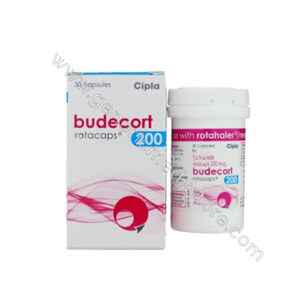
Description
Same active ingredient (budesonide) as Pulmicort®, the US brand. Budecort Rotacap 200 mcg is an Indian brand, made and licensed in India. Compare all Generic Pulmicort (Budesonide) options.
About Budecort Rotacap 200 mcg
Budecort Rotacap 200 mcg is a prescription inhalation capsule containing 200 mcg of budesonide as a dry powder, made by Cipla Limited, used every day to keep asthma under control. It is the middle Rotacap strength and a common adult dose: one capsule twice daily provides 400 mcg a day, a frequently prescribed maintenance amount.
How does Budecort Rotacap work?
When the powder reaches the small airways, budesonide binds to steroid receptors inside the cells of the airway wall. This reduces the production of inflammatory substances, lowers the number of inflammatory cells and makes the airway less leaky and swollen. Over several weeks the result is fewer symptoms and fewer attacks.
Dosing guide
Adults usually take 200–400 mcg twice daily, which is one or two capsules morning and evening. In severe asthma a specialist may go up to 800 mcg twice daily, which is simpler with the 400 mcg capsule. Children who need this strength typically take one capsule twice daily. If you miss a dose, take it when you remember unless the next one is nearly due, and never double up.
Using a Rotahaler or Revolizer
Load one capsule, then close the device so the capsule is pierced or separated, following its leaflet. Breathe out away from the mouthpiece. Put the mouthpiece between your teeth, close your lips firmly around it and take one quick, deep breath. Hold for as long as feels comfortable before breathing out through your nose.
Common technique mistakes
- Breathing in too gently, so powder stays behind in the capsule.
- Blowing into the device, which dampens the powder and makes it clump.
- Loading a capsule that has been out of its strip for hours.
- Skipping the mouth rinse, which raises the risk of thrush.
- Assuming the dose was taken without checking that the shell is empty.
Keeping track of your asthma
Good control means no night waking, few or no daytime symptoms, and a reliever used on two days a week or less. If you reach for your reliever more often, or wake at night with cough or wheeze, your treatment needs reviewing. A written asthma action plan from your doctor tells you what to do as symptoms change.
What are the side effects?
Possible effects include a hoarse or weak voice, throat irritation, a brief cough after inhaling and thrush in the mouth or throat. Headache and nausea are occasionally reported. Rarely, people feel anxious or restless, or notice blurred vision that should be checked by an eye doctor. Seek emergency care if your chest tightens sharply after a dose, if you have an allergic reaction with swelling or hives, or if you are too breathless to talk.
Who should not use it?
- Anyone allergic to budesonide.
- People with a severe milk-protein allergy should check the leaflet with a pharmacist, as dry powder capsules usually contain lactose as a carrier.
- It is never a substitute for a reliever during an attack.
- Extra care is needed with tuberculosis, untreated infections and liver disease.
- Ritonavir, cobicistat, itraconazole and ketoconazole can push budesonide levels up.
Budesonide is widely used in pregnancy and during breastfeeding; talk to your doctor rather than stopping.
Pack sizes and storage
Packs of 30, 60 or 90 capsules, from $6. Store below 86°F (30°C) somewhere dry, keeping each capsule in the foil until you load it.
Frequently asked questions
Can I switch between 100, 200 and 400 mcg capsules?
Only as prescribed. Budecort Rotacap 100 mcg suits lower doses and Budecort Rotacap 400 mcg higher ones.
What if my asthma is still not controlled?
Your doctor may move you to a combination such as Foracort Rotacaps (budesonide with formoterol).
Where are reliever capsules?
Asthalin Rotacaps contain albuterol (salbutamol); more options are in the asthma category.
Written for general awareness and not as medical advice. Budecort Rotacap 200 mcg is a prescription medicine; follow your prescriber’s instructions.
Helpful guides
- Types of Asthma Inhalers: Relievers, Preventers and How to Use Them CorrectlyLearn the types of asthma inhalers (relievers, preventers and combination inhalers), how each one works, and step-by-step tips for correct inhaler technique.