


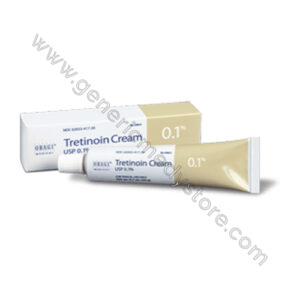
Description
Same active ingredient (tretinoin) as Retin-A®, the US brand. Tretinoin 0.1% Cream is an Indian brand, made and licensed in India.
About Tretinoin 0.1% Cream
Tretinoin 0.1% Cream is a prescription topical cream containing tretinoin 0.1%, made by Healing Pharma, India, used to treat acne vulgaris, especially persistent comedonal acne on oily skin. It is the strongest of the standard tretinoin cream concentrations, four times the strength of 0.025%, and is generally reserved for people whose skin already tolerates retinoids well.
How does tretinoin work?
Tretinoin binds to retinoic acid receptors in the skin and regulates how quickly the cells lining each follicle multiply and detach. At 0.1% this effect is more pronounced, so stubborn plugs loosen faster, but the skin barrier is also disturbed more, which explains the greater peeling and redness. It has a mild anti-inflammatory action too, and helps other acne treatments reach the follicle.
Is 0.1% the right strength for you?
- Often suitable: oily or thicker skin, stubborn comedones, and users who have completed several months on 0.05% without much irritation.
- Usually not a first choice: dry, sensitive or easily flushed skin, or anyone new to retinoids.
- Not suitable: eczema-prone or broken skin, rosacea, or pregnancy.
A higher percentage does not always mean faster results. If your skin becomes raw and inflamed, you may need to apply it less often, and your prescriber may move you back to Tretinoin 0.05% Cream.
How to use it
Once a day at bedtime, spread a pea-sized amount thinly over the whole affected area after cleansing and allowing your face to dry for 20–30 minutes. Avoid the eyes, the creases beside the nose and the corners of the mouth, where cream tends to collect and sting. Many dermatologists suggest two or three nights a week at first, even for experienced users, building to nightly use over a few weeks. Wash your hands after application and use SPF 30 or more each morning.
How long does it take to work?
The first month is mostly about adjustment. Blackheads usually start to reduce after 6–8 weeks, and the full effect on acne is judged at about 12 weeks. Carrying on afterwards helps stop new comedones forming.
What are the side effects?
Because this is the highest cream strength, dryness, scaling, stinging and redness are more likely and may be more marked than with lower concentrations. The skin is also more prone to sunburn and windburn, and uneven pigmentation can occur. Stop and see a doctor if you have blistering, crusting or significant swelling. Get urgent help for hives, facial swelling or difficulty breathing.
Cautions and interactions
- Not for use in pregnancy or when planning a pregnancy; ask a doctor about breastfeeding.
- Do not apply at the same time as benzoyl peroxide, which can break tretinoin down; use them at different times of day only if advised.
- Avoid salicylic acid, sulfur or resorcinol products, astringents and harsh scrubs on treated skin.
- Tell your prescriber about medicines that increase sun sensitivity, such as fluoroquinolones, tetracyclines or thiazides.
- Do not use waxing, laser or chemical peels on treated areas without advice.
Pack sizes and storage
20 g tubes in packs of 3, 6 or 9, from $20. Store below 77°F (25°C) and keep the cap on.
Frequently asked questions
Can I start with 0.1%?
Most people start lower, for example with Tretinoin 0.025% Cream, and increase if needed.
Is there a gel at this strength?
Yes, Tretoin 0.1% Gel suits very oily skin.
Where are other acne products?
In our acne category.
Educational content, not a personal recommendation. Tretinoin 0.1% Cream is a prescription medicine; use it only as directed by a doctor or pharmacist.
Helpful guides
- Tretinoin for Acne: Strengths, How to Use It and What to ExpectA complete guide to tretinoin for acne: which strength to start with, how to apply it step by step, the purging timeline…