

Description
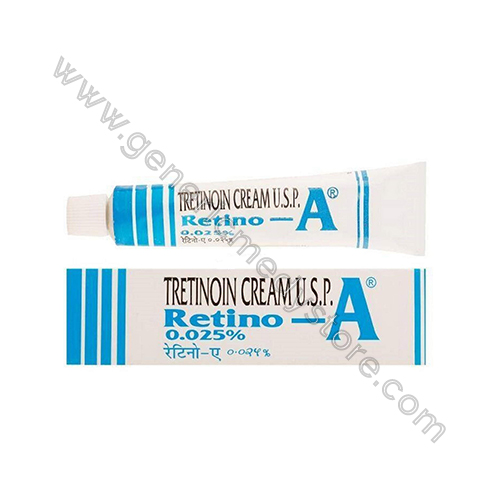
Same active ingredient (tretinoin) as Retin-A®, the US brand. Retino A Cream 0.025% is an Indian brand, made and licensed in India.
About Retino A Cream 0.025%
Retino A Cream 0.025% is a prescription cream containing tretinoin 0.025%, made by Janssen Pharmaceuticals in India, used to treat acne vulgaris. It is the mildest Retino-A strength and a common first retinoid for people with dry, sensitive or easily irritated skin.
How does Retino A Cream work?
Tretinoin is a retinoid, a close relative of vitamin A. It works inside the pore, making the cells that line it grow and shed normally rather than clumping into a plug. Blackheads and whiteheads gradually lift out, pores stay open, and the inflamed spots that grow from blocked pores become less frequent. Because it prevents acne rather than treating each spot, it is spread over the whole area where breakouts occur.
Why start with 0.025%?
- The low concentration causes less peeling and stinging while skin adapts.
- The cream base contains moisturizing ingredients, so it feels less drying than a gel.
- It is often chosen for first-time retinoid users, dry or fair skin, and cold, dry weather.
- It still treats comedonal acne effectively; a stronger product is not needed to see a benefit.
How to use Retino A Cream 0.025%
Once a day, at bedtime, wash with a gentle cleanser and let the skin dry completely for about 20 minutes. Take a pea-sized amount on a fingertip and smooth a thin layer over the forehead, cheeks, nose and chin. Keep it away from the eyes, the corners of the nose and the lips. If your skin feels tight, apply an oil-free moisturizer afterwards. Every morning, protect your face with SPF 30 or higher, even on cloudy days.
What to expect week by week
- Weeks 1–2: mild tightness, pinkness or fine flaking, particularly around the nose and chin.
- Weeks 2–4: a short-lived increase in spots as trapped plugs come to the surface.
- Weeks 6–8: fewer blackheads and new breakouts; skin texture often feels smoother.
- Week 12: the usual point to judge the result with your prescriber and decide whether to continue, step up or combine treatments.
What are the side effects?
Redness, dryness, peeling and a slight stinging are the most common and often settle as the skin adjusts. You will sunburn more easily. Occasionally tretinoin changes skin color temporarily. Stop using it and seek advice if you get blisters, crusting, severe swelling or an allergic rash.
Precautions
Avoid tretinoin if you are pregnant or planning a pregnancy, and check with your doctor if you are breastfeeding. Do not apply it to eczema, sunburn, cuts or grazes. Harsh soaps, exfoliating scrubs, alcohol-based toners and other peeling products add to irritation. If a doctor has also prescribed benzoyl peroxide, use that in the morning. Do not wax areas being treated.
Pack sizes and storage
Each tube contains 20 g, sold in packs of 2, 4 or 6 tubes, from $10. Store at room temperature, below 77°F (25°C), and replace the cap after use.
Frequently asked questions
What is the next strength up?
Retino A Cream 0.05%, if your doctor thinks you need it.
Is there another 0.025% cream?
Tretin 0.025% Cream has the same concentration in a larger 30 g tube from a different maker.
Where can I learn more?
Read our tretinoin for acne guide or browse the acne range.
Educational content only. Retino A Cream 0.025% is a prescription medicine; follow your prescriber’s instructions and ask a pharmacist if unsure.
Helpful guides
- Tretinoin for Acne: Strengths, How to Use It and What to ExpectA complete guide to tretinoin for acne: which strength to start with, how to apply it step by step, the purging timeline…